
How do you figure out what you want in life?
Try a want–need–test exercise to figure out what you want in life. Separate wants from expectations, name constraints, and use the blank worksheet.
You can be capable at managing your life and still be unsure what you want from it. To figure out what you want in life, start with one area, write down a desired change, and ask what that change would make room for. Separate your own interest from outside expectations, then try a small, reversible version before making a large commitment.
How do you figure out what you want in life?
One way to figure out what you want in life is to move from a broad wish to a specific experience you can explore. “A different life” is difficult to act on; “more time making things without being evaluated” gives you something to investigate. You don't need a final answer about your future to identify a preference worth taking seriously.
Try the exercise below on paper or in a private note. It's a way to organize your thoughts, rather than a test with a correct result.
1. Choose one part of life, not your whole future
Pick the area that keeps coming to mind: work, friendship, home, creativity, or how you spend your free time. Leave the others outside this exercise for now.
Finish these three sentences with details from an ordinary week:
- “I would like more…”
- “I would like less…”
- “I want to keep…”
The third sentence matters. If you want more adventure but also want to keep your close relationships and a manageable budget, those are part of the picture. You don't have to erase what's good to explore what's missing.
If you can't yet name an area and the feeling is broader than a particular choice, When life feels stuck offers questions for noticing what's missing and looking for one small spark of curiosity before deciding what to change.
2. Ask what the desired change would give you
Write one want, then complete: “If I had that, an ordinary day would include more…” Keep going until you can describe an experience rather than a label such as “successful” or “better.”
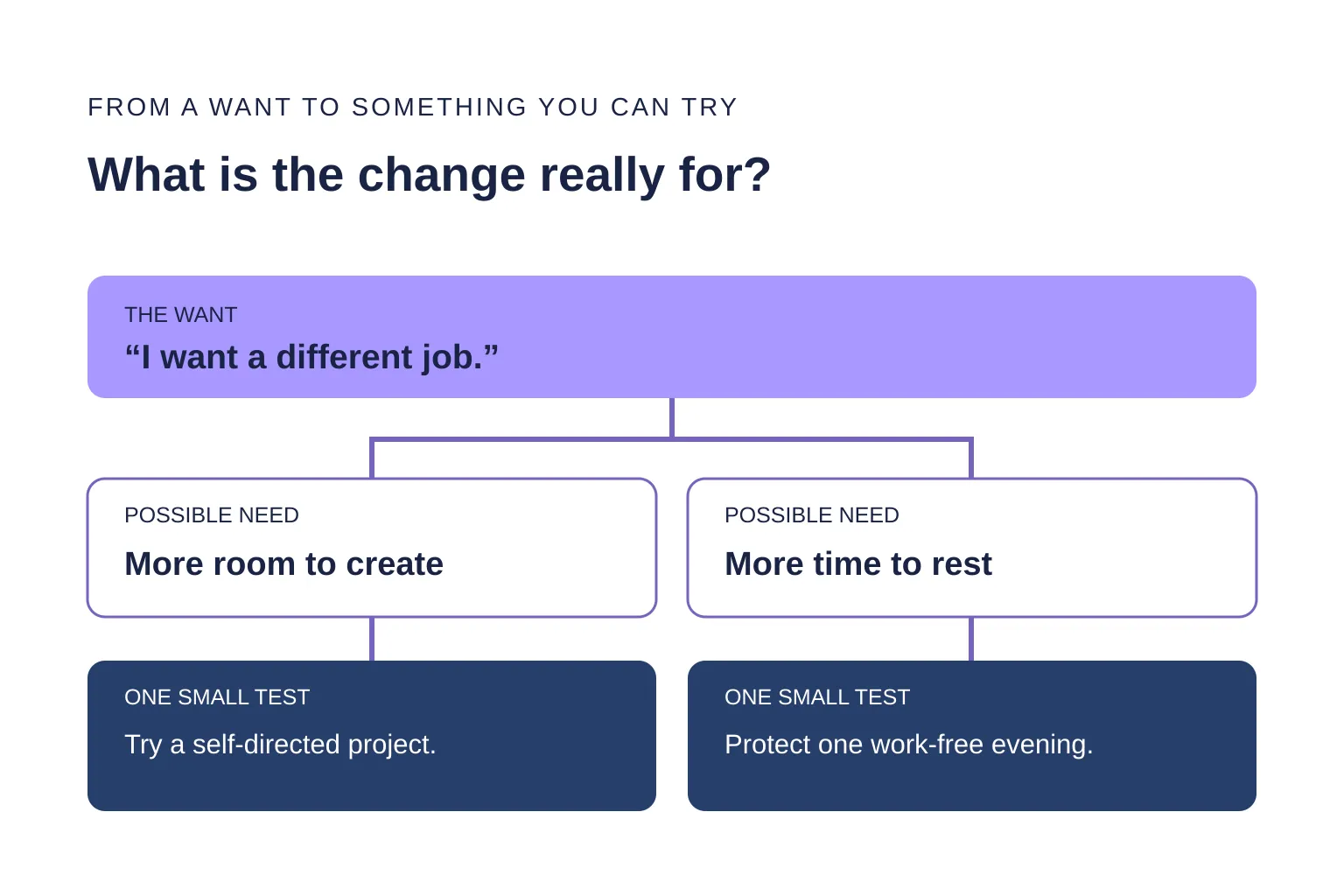
Say you write, “I want a different job.” There are several possible meanings:
| What you hope a different job would give you | A small way to explore that preference |
|---|---|
| More room to create | Try a short, self-directed project and notice which parts you want to keep doing. |
| More time to rest | Protect one work-free evening, if your circumstances allow, and notice what still feels missing afterward. |
| More connection with colleagues | Arrange a conversation with someone who does work you're curious about; ask what collaboration actually looks like. |
These are clues, not a verdict about whether you should stay or leave. A pleasant evening won't settle a career decision. But distinguishing rest from creativity helps you ask better questions about the next job—or about a change you could request in the current one.
3. Separate “I want” from “I should want”
Look at the same desire through two questions:
- “Who would approve of this choice?”
- “If nobody knew I had chosen it, what part would I still enjoy?”
Wanting approval doesn't invalidate a desire. The point is to see whether there is something in it for you beyond being admired or meeting an expectation.
For example, wanting a leadership role might contain both pride in the title and a genuine interest in mentoring people. Write those separately. Then ask someone in that role how much of their week involves mentoring, meetings, administration, and difficult decisions. You may want the activity more than the position.
4. Put the want beside your real constraints
A preference becomes easier to explore when you include the life you're actually living. Name the time, money, care responsibilities, health needs, or agreements a choice would affect.
Use this sentence:
“I want more ___, while protecting ___.”
“I want more creative work, while protecting the income my household depends on” points toward a different first step than “I want to leave my job immediately.” It might lead to a conversation about responsibilities, a small project, or gathering information about another role.
If you want two things that conflict, ask what enough of each could look like this month. More solitude and closer friendships might fit as one quiet evening and one unhurried visit. That doesn't resolve every tension; it gives both preferences a place in the conversation.
5. Make one test and decide how you'll review it
Choose something small enough to stop or adjust. Give it a time boundary and a question to answer, so it doesn't become another open-ended obligation.
For the creative-work example, your note might read:
“On Saturday, I'll spend 30 minutes making a small photo series with the camera I already own. I want to find out whether I enjoy choosing and shaping the project, not whether I'm good at photography.”
Afterward, record:
- What you actually enjoyed, rather than what you hoped to enjoy.
- What got in the way: the activity itself, the setting, or its timing.
- Whether you want to repeat it, change one part, or set it aside.
Enjoying a test doesn't mean you should turn it into a career. Disliking one attempt doesn't settle the question either. If you liked making photos but hated rushing, try another time before deciding the activity doesn't fit.
Save or print a blank want–need–test worksheet
Use the worksheet below to try the same exercise with your own desired change. Open the full-size blank worksheet to zoom in or save it: on a phone, touch and hold the image; on a computer, right-click and choose Save Image As.
Download the blank want–need–test worksheet (PDF). One printable page with five prompts and writing space; fits Letter or A4. Print in portrait on Letter or A4 paper at actual size (100%).
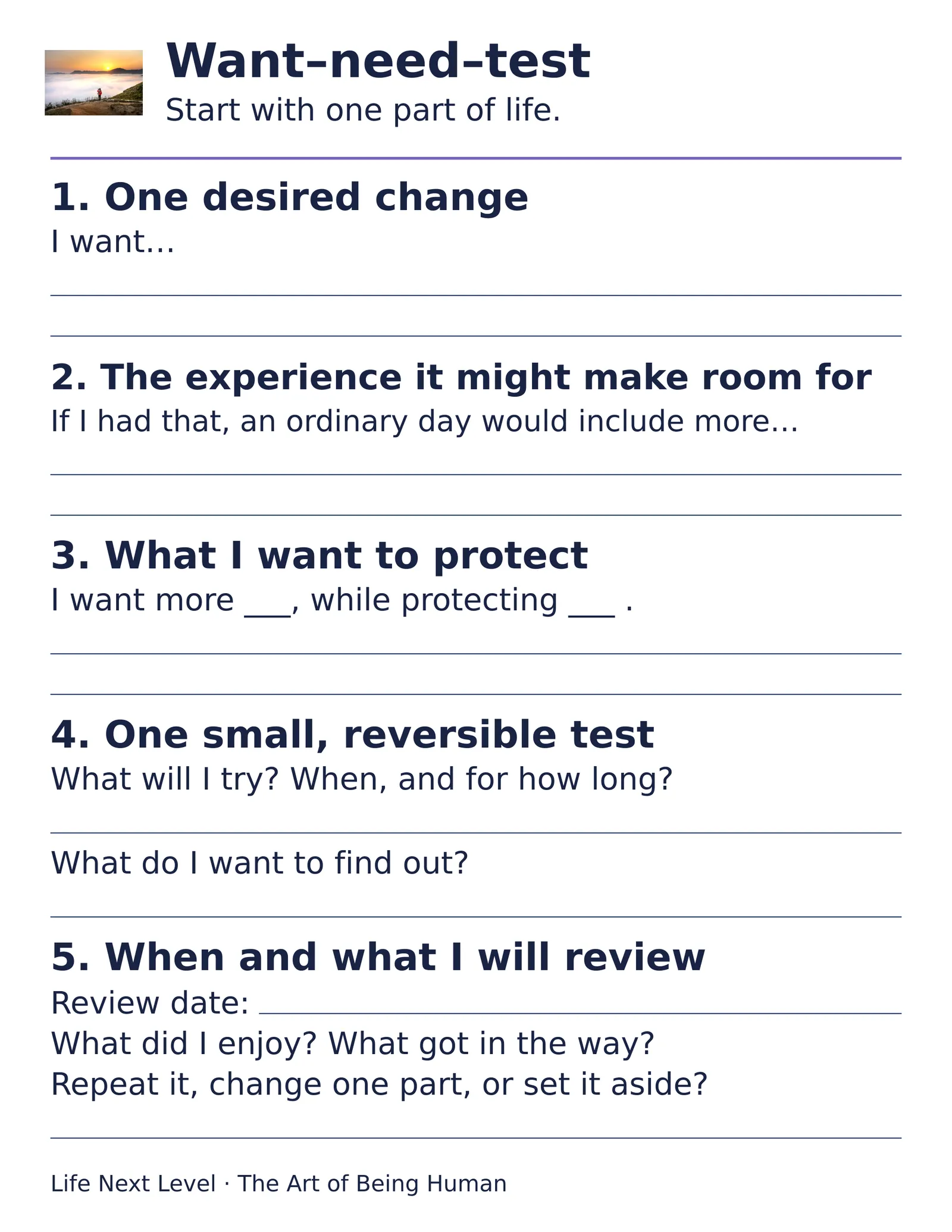
If you prefer a private note or your own sheet of paper, copy these prompts:
- One desired change: “I want…” Start with one part of life.
- The experience it might make room for: “If I had that, an ordinary day would include more…”
- What I want to protect: “I want more ___, while protecting ___.”
- One small, reversible test: “What will I try? When, and for how long? What do I want to find out?”
- When and what I will review: “Review date: ___. What did I enjoy? What got in the way? Repeat it, change one part, or set it aside?”
What if you only know what you don't want?
Start with the unwanted detail and ask for its practical opposite. “I don't want every evening to disappear into errands” might become “I want one evening with nothing scheduled.” “I don't want shallow friendships” might become “I want someone I can talk honestly with.”
If every possible choice feels flat, you can pause the exercise. Persistent loss of interest, distress, or difficulty functioning is worth discussing with a qualified health professional; reflection alone may not be the support you need.
For now, choose one sentence to finish: “I want more ___, while protecting ___.” Let that be enough to begin.